
You’ve built a solid IT training institute. Your instructors are experienced. Your curriculum covers NetApp, cloud storage, and enterprise technologies. Students who complete your programs get good jobs. Yet you’re constantly struggling to fill batches with quality candidates who actually complete courses and succeed.
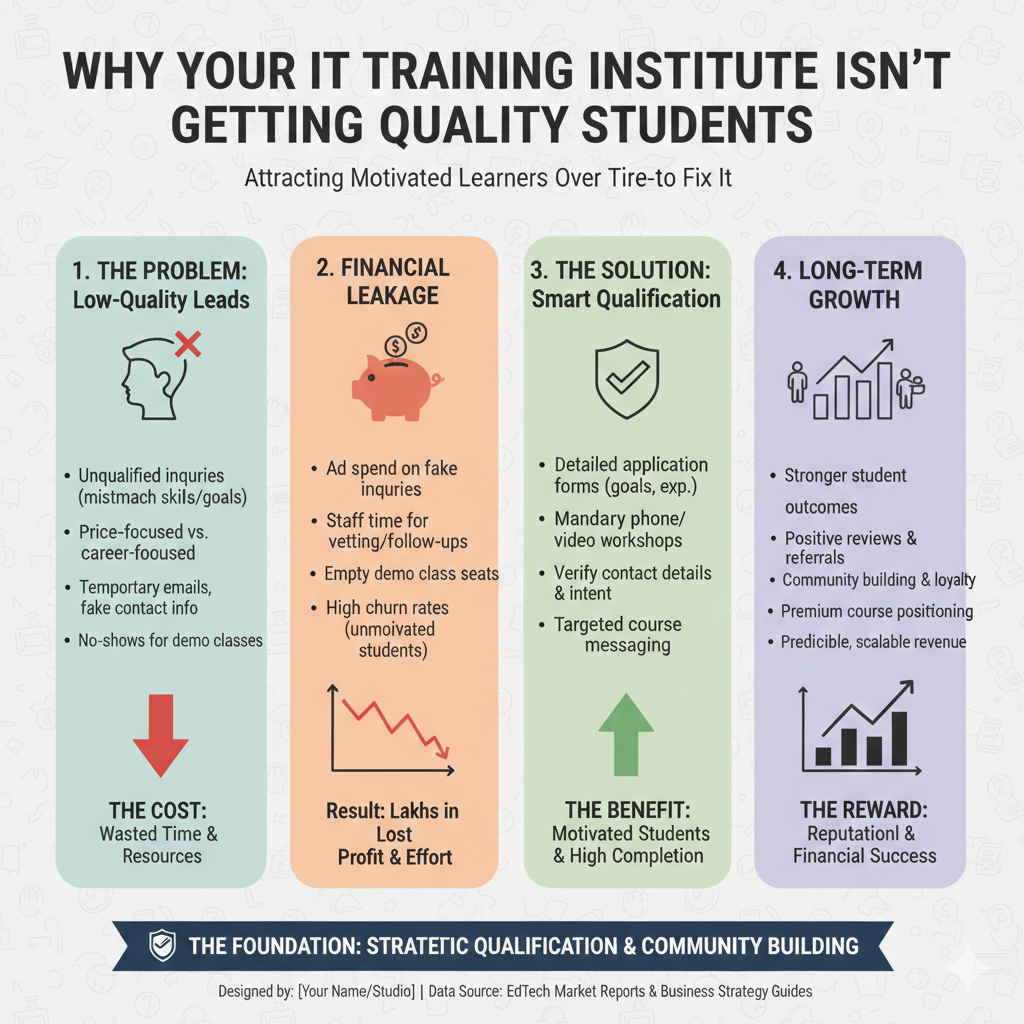
Most training institute owners blame the market. “Students only want cheap courses.” “Everyone goes to big brands.” “The market is too competitive.” Meanwhile, a small percentage of IT training providers have 70-80% of revenue from repeat corporate clients and consistent student referrals. Same market, completely different results.
After analyzing what separates struggling training institutes from thriving ones in the enterprise IT education space, I’ve identified seven critical issues destroying student quality and enrollment — and more importantly, how to fix each one.
Your Institute Name Is Costing You Corporate Clients
Here’s a revealing test: Ask five satisfied students or corporate clients to recommend your training institute to their colleagues. Can they remember your exact name? Can they find you when they search online?
Most cannot. And this invisible problem costs you lakhs in lost corporate training contracts monthly.
I recently consulted with a NetApp training provider who couldn’t understand why corporate referrals never materialized despite excellent training delivery and strong student outcomes. His institute was called “Tech Training Academy” with a focus on NetApp and cloud storage.
The problem: There are 200+ training institutes in India using variations of “Tech Training,” “Tech Academy,” “Technology Institute,” etc. When his delighted corporate clients tried to refer his services to other companies, they’d search “tech training NetApp” or “technology academy storage courses.” They’d find dozens of competitors, not him. Some referrals ended up contracting competitors while genuinely believing they were following the original recommendation.
This isn’t just about SEO rankings. It’s about basic recall and discoverability. If corporate training managers can’t remember your exact name or easily find you when searching, your word-of-mouth marketing is fundamentally broken.
The solution requires understanding the competitive landscape before investing more in marketing with a forgettable name. Check how many similar institutes exist. You might discover your name is drowning in a sea of nearly identical competitors, making you effectively invisible to potential corporate clients and serious students trying to find you.
One training provider I advised changed from “Cloud & Storage Training Institute” to a unique, memorable brand after discovering 47+ competing institutes with “Cloud,” “Storage,” or “Training Institute” in their names. His corporate inquiry rate increased 165% within three months simply because decision-makers could now actually find him when searching.
If you’ve already built brand equity, complete rebranding isn’t necessary. You can evolve by adding a unique identifier, emphasizing a memorable element, or creating distinct visual branding. The goal is to be findable when satisfied clients try recommending you to others.
Your Lead Emails Are Full of Junk Inquiries
Most training institutes collect student email addresses through inquiry forms, webinars, and free resources. Smart lead generation strategy in theory. But here’s the harsh reality:
45-60% of the email addresses you collect never convert to paying students. Worse, they actively waste your sales team’s time with fake inquiries.
Consider the typical inquiry journey: Someone sees your NetApp training advertisement. They’re mildly curious, maybe comparing options, or just browsing with no immediate intent. They fill out your “Download Free Course Syllabus” form, which requires an email address. They use a temporary, disposable email to grab the PDF without committing to anything.
Your sales team sees a “new lead,” spends 30-45 minutes preparing personalized follow-up, explaining course benefits, answering questions via email. The emails bounce or go unanswered because that address died 24 hours after the inquiry.
This creates multiple problems simultaneously:
Wasted Sales Time: Your team spends 15-20 hours weekly chasing ghost leads that were never real prospects. That’s 80 hours monthly that could be spent nurturing genuine students.
Polluted Analytics: Your conversion metrics look terrible. “We had 200 inquiries but only 15 enrollments” makes you think your courses or pricing are problems. The actual problem? 120 of those inquiries were never real.
Damaged Email Reputation: Email service providers track bounce rates. When you’re constantly sending follow-ups to invalid addresses, your domain gets flagged. Eventually, even your legitimate emails to serious students start landing in spam folders.
Skewed Marketing ROI: You run Facebook ads, generating 100 leads at ₹500 per lead. Spend ₹50,000 on advertising. But 60 leads were fake, meaning your actual cost per real lead is ₹1,250, not ₹500. You make marketing decisions based on false data.
The solution involves validating email quality at the collection point. When someone provides an email address to download resources or request information, your system should verify it’s a legitimate, permanent address rather than a temporary one that will die immediately.
This doesn’t mean rejecting interested people — it means politely requesting a real email if they want to receive course information, batch updates, and important communications. Serious students don’t mind providing real contact information. Casual browsers with zero intent move on. Either outcome is better than building a ghost email database.
This also prevents your sales team from becoming demoralized. When they spend entire days following up on leads that never respond, they start assuming all leads are worthless and stop trying. When they follow up on qualified leads with verified emails, conversion rates improve dramatically and morale stays high.
You’re Wasting Hours on Fake Corporate Training Inquiries
Not all corporate training inquiries are real opportunities. Some are competitors researching your pricing and curriculum. Some are college students working on MBA projects. Some are HR managers with zero budget just exploring future possibilities.
The problem intensifies when these fake inquiries come through temporary email addresses on business listing platforms. You spend 2-3 hours preparing detailed proposals for “corporate batch training for 20 NetApp engineers,” customizing curriculum, calculating pricing, and scheduling meetings with decision-makers. Then complete silence. No responses to follow-ups. The email address stops working.
This isn’t just frustrating — it’s expensive. If you spend three hours on proposals for serious opportunities, that’s valuable business development. If 50% of your corporate proposals go to fake inquiries, you’re wasting 15-20 hours weekly on leads that were never real.
Better qualification upfront prevents massive time waste. Simple verification like requesting company GST number, asking for LinkedIn profiles of decision-makers, scheduling brief qualification calls before detailed proposals, or filtering obvious temporary emails during initial contact saves enormous time.
One NetApp training institute implemented basic inquiry qualification and email validation. Their proposal-to-contract conversion rate jumped from 12% to 41% — not because their proposals improved, but because they stopped wasting time on fake opportunities and could focus energy on genuine corporate clients.
Your Course Pages Aren’t Being Found on Google
You’re relying on LinkedIn posts, maybe some Facebook ads, possibly listing on Sulekha or JustDial. But here’s a critical question: When someone Googles “NetApp training online India” or “ONTAP certification course,” does your institute appear on first page?
Probably not.
Most small training institutes focus entirely on social media and paid platforms, forgetting that Google organic search is still how serious students and corporate training managers research providers. A VMware admin looking to upskill Googles “netapp ontap training,” sees three competitors, and shortlists them. You never even knew they were searching.
The technical problem is usually your website sitemap. Search engines need a clear, properly formatted map of all your course and content pages to index them correctly. If Google doesn’t know your “NetApp ONTAP Administration Course” page exists, it cannot show that page when people search for exactly what you offer.
This is especially painful for specific technical searches. Someone searching “azure netapp files training” or “aws fsx certification course” is a high-intent prospect ready to enroll. If your relevant course pages aren’t indexed properly, they find competitors instead, and you never knew the opportunity existed.
The fix is straightforward but often overlooked: generate a proper XML sitemap listing all your course pages, blog content, and instructor profiles, then submit it to Google Search Console. Many modern website platforms do this automatically, but if you’re running a custom site or older platform, you need to handle this manually.
Tools exist that crawl your website and generate comprehensive sitemaps automatically. This isn’t glamorous technical work, but it’s the difference between being invisible to serious students actively searching for NetApp training and capturing high-intent organic traffic that competitors completely miss.
Your Pricing Structure Signals Desperation
Pricing psychology matters enormously in IT training. How you structure and present prices tells prospects whether you’re a professional training institute or someone running courses from home to make quick money.
If all your courses are roughly the same price regardless of duration, complexity, or outcomes, you look like someone who doesn’t understand value differentiation. If your prices are 40% below market across the board, serious students suspect quality compromises or inexperienced instructors.
Here’s what professional training institutes do differently:
Clear Value Tiers: They separate foundation, professional, and expert-level courses with appropriate pricing. “NetApp Fundamentals: ₹12,000. ONTAP Administration Certification: ₹22,000. Advanced Data Protection + Cloud Integration: ₹35,000.” This helps students self-select based on current skill level and career goals.
Outcome-Based Pricing: Positioning prices around outcomes rather than hours. “Get NetApp certified and increase earning potential by ₹5-8 lakh annually — Investment: ₹22,000” makes the ROI obvious. Students aren’t buying 25 hours of lectures; they’re buying career transformation.
Corporate vs Individual Pricing: Clear differentiation. Individual students pay standard rates. Corporate batch training (5-10 employees) gets volume pricing but higher per-seat rates than individual. This prevents corporate clients from gaming individual pricing.
Payment Plans: “₹22,000 full payment or ₹8,000 + ₹8,000 + ₹7,000 in 3 installments” makes high-value courses accessible without devaluing them through discounting.
Review your pricing structure honestly. If it looks random and inconsistent rather than strategic and outcome-focused, you’re both leaving money on table and signaling unprofessionalism to serious students and corporate clients comparing multiple providers.
You Have No Systematic Student Success Follow-Up
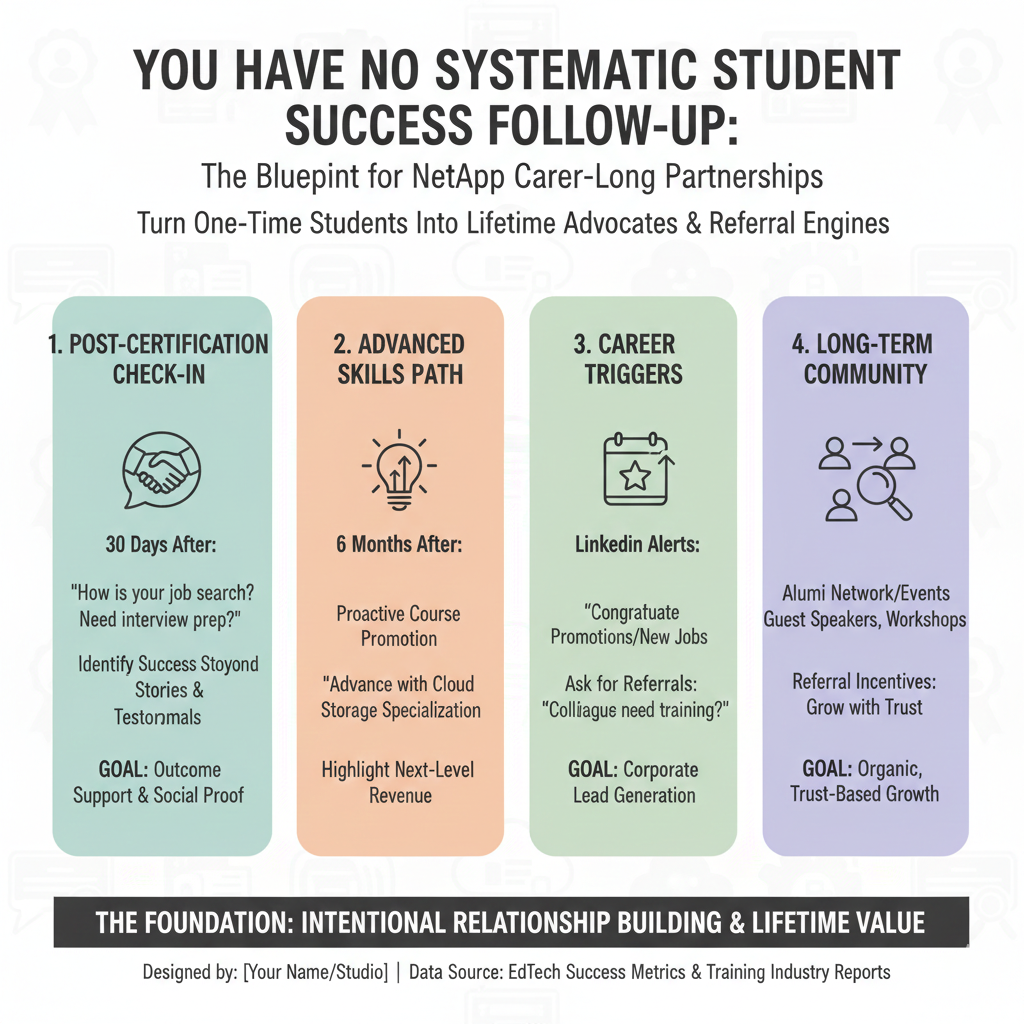
After a student completes your NetApp certification course, what happens? If the answer is “nothing until we announce the next batch,” you’re leaving massive revenue and referral potential on table.
Acquiring new students is expensive through ads, listings, and marketing. Repeat students and their referrals are essentially free revenue since acquisition cost is zero.
Yet most training institutes treat course completion as the end of the relationship rather than the beginning of an ongoing partnership.
Successful training institutes have systematic follow-up sequences:
30 Days Post-Certification: “Congratulations on completing certification! How is your job search progressing? Do you need interview preparation support?” This shows you care about outcomes, not just collecting course fees.
90 Days Post-Certification: “Have you applied your NetApp skills in real projects yet? We’re compiling success stories from recent graduates.” This creates social proof and identifies potential testimonials.
6 Months Post-Certification: “Ready to advance your skills? Our Cloud Storage Specialization (Azure ANF + AWS FSx) is perfect for NetApp-certified professionals looking to expand expertise.” This generates repeat enrollment revenue.
Job Change Triggers: When LinkedIn shows your graduates changed jobs or got promotions, reach out congratulating them and asking if colleagues at their new company need training. One successful graduate at a new company can generate 5-10 corporate enrollments.
This doesn’t require expensive CRM automation. A simple spreadsheet tracking course completion dates and a calendar reminder system works perfectly when managing 100-200 graduates. As you grow to 1,000+ graduates, basic CRM tools handle it easily.
The key is intentionality. Treat student relationships as ongoing connections with periodic valuable touchpoints, not one-time transactions. The training institutes making ₹50-80 lakh annually typically have 60-70% of revenue from repeat students and their referrals. This doesn’t happen by accident.
You’re Invisible to High-Value Corporate Clients
The corporate training market (IT companies, service providers, enterprises upgrading infrastructure) represents 70-80% of total enterprise training spending. Yet most small institutes focus almost exclusively on individual students.
Why? Because reaching corporate buyers requires different marketing than posting on Facebook about upcoming batches.
Corporate training managers search differently. They Google “corporate netapp training India” or “enterprise storage certification for teams.” They ask their professional networks for provider recommendations. They check industry-specific LinkedIn groups and forums.
If your marketing is entirely student-focused, you’re invisible to the much larger corporate market.
The fix requires strategic positioning for corporate buyers:
Corporate-Specific Landing Pages: Create dedicated pages targeting corporate training needs. “Enterprise NetApp Training for IT Teams” with case studies, batch customization options, and corporate pricing structures. This ranks for corporate searches.
LinkedIn Presence: Corporate training managers live on LinkedIn. Regular content showcasing successful corporate training outcomes, technical insights, and industry trends builds visibility with decision-makers.
Customization Capability: Corporations don’t want off-the-shelf courses. They want curriculum matching their specific NetApp deployments, timelines fitting their schedules, and training at their locations or convenient times. Showcasing this flexibility attracts corporate contracts.
Professional Invoicing & Documentation: GST invoices, proper training completion certificates, detailed proposals — corporate buyers expect professional business practices that many student-focused institutes neglect.
One training institute added corporate-focused content and landing pages, started publishing weekly LinkedIn content targeted at IT managers, and showcased successful corporate training outcomes. Corporate inquiries increased from 15% to 62% of total requests within four months. Same expertise, same courses, just visible to buyers who were previously finding competitors.
The Real Problem Might Be Simpler
Sometimes training institutes struggle not because of sophisticated marketing failures but because of basic execution issues.
Ask yourself honestly:
- Do you respond to inquiries within 3 hours during business hours?
- Are your course start dates clear and consistently met?
- Do instructors actually have real-world NetApp implementation experience?
- Is your lab infrastructure reliable and accessible?
- Do you provide recorded lectures for students who miss live sessions?
- Are course completion certificates professional and verifiable?
A training institute with mediocre marketing but exceptional student outcomes will outperform an institute with brilliant marketing but poor training delivery every single time.
In IT training where reputation travels fast through professional networks and LinkedIn recommendations, one badly executed batch can cost you 20 potential corporate clients. One exceptional batch can generate 50-60 inquiries over the following months through word-of-mouth.
Your 30-Day Fix Plan
Here’s a systematic approach:
Week 1 – Audit: Check name uniqueness, analyze email database quality, review Google visibility, test inquiry-to-enrollment process
Week 2 – Technical Fixes: Generate and submit a proper sitemap, implement email validation, optimize mobile inquiry experience, set up proper tracking
Week 3 – Strategic Adjustments: Create corporate-focused landing pages, develop student success follow-up templates, review pricing structure, build outcome-focused messaging
Week 4 – Launch and Monitor: Implement systematic follow-up, track conversion improvements, gather feedback, adjust based on results
The Bottom Line
Your training institute isn’t failing to attract quality students because the market is saturated or because big brands dominate. It’s failing because of specific, fixable issues in your systems, positioning, visibility, or follow-up processes.
The difference between an institute doing ₹15 lakh annually with constant struggle and an institute doing ₹80 lakh with 65% repeat/referral business often isn’t the quality of training delivered. It’s these invisible optimization details that amateurs ignore and professionals systematically address.
Fix these issues, and you don’t need to be perfect — you just need to be measurably better than the 80% of competitors who never systematically tackle these problems.
The question is whether you’ll invest the effort to diagnose and fix what’s actually broken rather than just working harder at acquiring students while losing past ones to competitors who do follow-up better.