
The IT industry is brutal right now. VMware admins are worried about Broadcom’s changes. Windows Server specialists see their skills becoming commoditized. Generic cloud engineers are flooding the market, driving rates down. Meanwhile, a small group of IT professionals quietly tripled their income over 18 months by adding one strategic skill: NetApp storage administration.
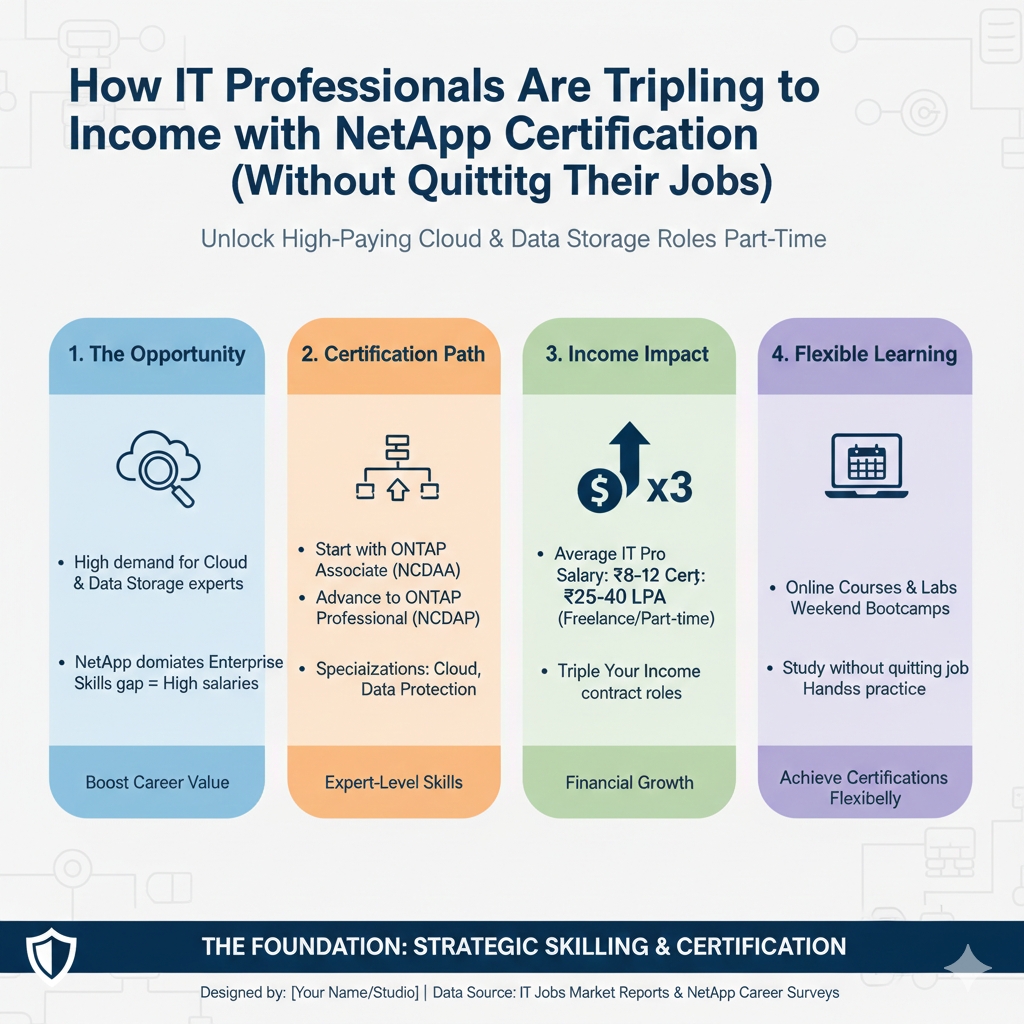
I’ve watched sysadmins go from ₹6 lakh annual packages to ₹18-22 lakh offers. I’ve seen freelance consultants increase their hourly rates from ₹2,500 to ₹10,000. Here’s exactly how they’re doing it — and why NetApp certification is the career move most IT professionals are completely overlooking.
The Hidden Market Nobody’s Talking About
Every IT professional knows about AWS, Azure, Kubernetes, and DevOps certifications. The competition is insane. Thousands of certified professionals chase the same jobs, driving salaries down and making differentiation nearly impossible.
NetApp storage administration sits in a completely different space. Here’s why it’s lucrative:
Enterprise Dependency: Large organizations (banks, telecom, healthcare, government) run critical data on NetApp storage systems. These systems can’t fail. They need certified experts, not enthusiasts who learned from YouTube.
Skill Scarcity: While 50,000+ people pursue AWS certifications annually in India, maybe 2,000-3,000 pursue NetApp. The supply-demand imbalance is massive.
High Stakes: Storage failures cost companies crores. A misconfigured NetApp cluster at a bank could lose transaction data. Organizations pay premium rates for people who won’t make expensive mistakes.
Global Demand: NetApp skills are valued worldwide. US and European companies sponsor H1B/work visas for NetApp-certified engineers because they can’t find local talent.
This combination — high demand, low supply, high stakes — creates exactly the market conditions that generate premium salaries and consulting rates.
Why Smart VMware Admins Are Pivoting Now
VMware administrators are particularly well-positioned for this transition, but they’re also the most at risk if they don’t move fast.
Broadcom’s acquisition of VMware created massive uncertainty. Licensing changes, product consolidation, and market disruption mean VMware-only specialists face career risk. The smart ones are diversifying before forced to by layoffs or stagnant careers.
NetApp training provides natural synergy with VMware skills:
- Both involve enterprise infrastructure
- Both require understanding of high availability and disaster recovery
- Both integrate with corporate data centers
- Both command premium rates in the market
But NetApp has something VMware is losing: scarcity. There are hundreds of thousands of VMware admins globally. There are maybe 20,000-30,000 NetApp specialists. That scarcity translates directly to higher compensation and job security.
One VMware admin I advised added NetApp ONTAP certification while still working his ₹9 lakh job. Within four months, he had three job offers ranging from ₹16-19 lakh. He negotiated his current employer up to ₹14 lakh just by showing the competing offers. Total time investment? 25 hours of focused training plus 40 hours of hands-on lab practice.
The Freelance Consulting Arbitrage
If you’re already doing freelance IT consulting, NetApp certification might be the highest-ROI investment you’ll ever make.
Generic IT consultants in India charge ₹1,500-3,000 per hour for basic sysadmin work, cloud migrations, or troubleshooting. NetApp storage consultants charge ₹8,000-15,000 per hour for the same time investment.
Why the massive difference? Risk and scarcity.
When a company calls a NetApp consultant, it’s because:
- Their production storage is having issues (high urgency)
- They’re implementing new storage infrastructure (high budget)
- They’re migrating critical data (high stakes)
- They can’t find in-house expertise (supply shortage)
All four factors push rates up dramatically. And because NetApp projects often involve multiple days or weeks of work, a single consulting engagement can generate ₹2-5 lakh in revenue.
The challenge most IT professionals face when considering consulting: they lack differentiation. “I do cloud migrations and general IT consulting” doesn’t win premium clients. “I specialize in NetApp ONTAP storage implementation and cloud integration (Azure ANF, AWS FSx)” wins ₹8 lakh projects.
But here’s what nobody tells you about starting a consulting practice: the administrative overhead kills most attempts. Managing inquiries across LinkedIn, email, WhatsApp, and phone calls while working full-time creates chaos. Losing track of which potential client you quoted, which follow-ups are pending, and which platforms are generating actual leads versus spam wastes enormous time.
Successful IT consultants set up separate professional communication channels from day one. One email specifically for client inquiries, another for certification bodies and training platforms, another for vendor communications. This prevents your primary client-facing email from getting buried in promotional messages from every training platform and tech vendor that wants to sell you something.
Many also use temporary email addresses when testing new business listing platforms or IT community forums they’re unsure about. This keeps their main business inbox clean and protects against the spam that inevitably follows when you sign up for professional directories.
The organization matters more than you’d think. When a potential ₹5 lakh consulting project emails you, missing that inquiry because it’s buried under 200 promotional emails from LinkedIn Learning, Udemy, and various vendor newsletters is the difference between winning business and wondering why consulting isn’t working.
Building Your Personal Brand in a Crowded Market
NetApp certification is valuable, but certification alone doesn’t generate opportunities. You need visibility. The problem? Every IT professional faces the same challenge: standing out in a market flooded with “certified cloud engineers” and “DevOps specialists.”
Your professional name and brand identity matter enormously here. I’ve seen excellent NetApp engineers struggle to get consulting work because their LinkedIn profiles and professional presence were generic and forgettable.
Before investing time building your NetApp consulting brand, research what already exists. One consultant I advised almost launched “CloudStorage Pro” as his consulting identity before discovering there were 40+ similar brands — “CloudPro Services,” “CloudStorage Solutions,” “Pro Cloud Experts,” etc. When potential clients tried to find him after meeting at conferences or through referrals, they’d find dozens of similar names and couldn’t remember which was his.
He changed to a unique, memorable brand identity after checking market saturation. His referral conversion rate increased dramatically simply because people could actually find him when searching.
This applies whether you’re freelancing or seeking employment. When recruiters search LinkedIn for “NetApp storage specialist,” hundreds of profiles appear. If your profile headline is generic (“IT Professional | Cloud & Storage”), you’re invisible. If it’s specific and unique (“NetApp ONTAP Specialist | Azure ANF & AWS FSx Implementation”), you stand out.
The same principle applies to consulting website domain names, social media handles, and professional portfolios. Generic names get lost. Unique, searchable identities get found.
The Learning Path That Actually Works
Most IT professionals fail at certification not because the material is too hard, but because their approach is scattered and unsustainable.
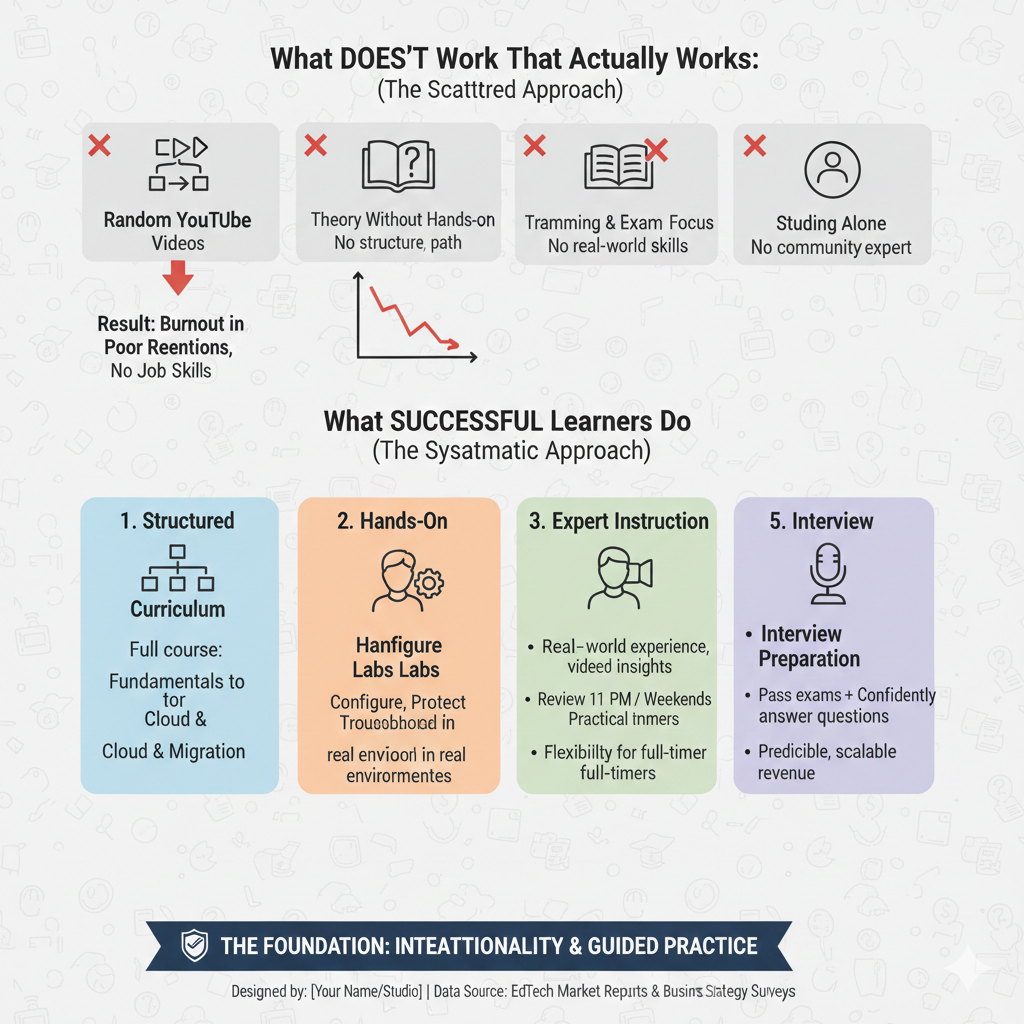
Here’s what doesn’t work:
- Watching random YouTube videos about NetApp when you feel motivated
- Reading official documentation without hands-on practice
- Attempting certification exam without structured preparation
- Studying alone without community support or expert guidance
Here’s what successful NetApp learners do differently:
Structured Curriculum: Follow a complete, logical course covering fundamentals through advanced topics. NetApp ONTAP administration, data protection, cloud integration (Azure ANF, AWS FSx, Google Cloud CVS), and migration strategies in proper sequence.
Hands-On Labs: Storage administration cannot be learned theoretically. You need to actually configure clusters, set up data protection, troubleshoot issues, and perform migrations in lab environments. Employers and clients can instantly tell the difference between someone who’s done it and someone who’s read about it.
Expert Instruction: Learning from someone with real-world NetApp implementation experience versus learning from generic training materials makes enormous difference in comprehension and practical application.
Recorded Content Access: Working full-time means you can’t attend every live session. Having recorded lectures to review at 11 PM after work or on weekends determines whether busy professionals actually complete certifications.
Interview Preparation: Passing certification exams proves knowledge. Confidently answering technical interview questions or client queries requires different preparation. The best training programs include both.
Most IT professionals underestimate time requirements. NetApp ONTAP administration fundamentals require 25-30 hours of focused learning plus 40-50 hours of hands-on lab practice. Trying to compress this into two weeks while working full-time leads to burnout and poor retention.
The sustainable approach: 2-3 hours daily, 5 days weekly, for 6-8 weeks. This allows time to practice concepts, review recordings, and build genuine competency rather than cramming for exam pass rates that don’t translate to job performance.
The ROI That Most IT Professionals Don’t Calculate
NetApp training costs ₹15,000-25,000 for comprehensive programs. Most IT professionals see this price and hesitate, comparing it to free online resources or cheaper generic certifications.
This comparison misses the actual ROI calculation:
Salary Increase: Average NetApp-certified professional sees ₹3-6 lakh annual salary increase within 12 months. That’s ₹25,000-50,000 monthly. The training pays for itself in the first month of higher salary.
Consulting Rate Arbitrage: Freelancers typically see 3-4x hourly rate increases. From ₹2,500/hour to ₹8,000-10,000/hour. Land just one 40-hour consulting project and you’ve covered training costs with ₹3 lakh profit remaining.
Career Insurance: In uncertain times (acquisitions, layoffs, company pivots), having scarce skills creates job security. The value of not being desperately job hunting when 200 other VMware admins from your company get laid off? Priceless.
Global Opportunity Access: NetApp certification opens international job markets. A position in Singapore, Dubai, or the US becomes realistic when you have skills those markets desperately need. The lifetime earning potential difference is measured in crores.
Time Savings: Learning a structured curriculum from experts takes 25-30 hours. Teaching yourself from scattered resources takes 100+ hours and still leaves knowledge gaps. The time saved alone justifies the investment.
Compare this to generic certifications, where 100,000 people hold the same credential. The incremental value to your career is minimal. Scarce, high-demand certifications generate asymmetric returns — small investment, massive career impact.
Common Mistakes That Waste Time and Money
After watching hundreds of IT professionals pursue NetApp certification, here are the mistakes that consistently destroy success:
Choosing Wrong Starting Point: Jumping into advanced topics before understanding fundamentals. NetApp architecture, ONTAP basics, and storage concepts must be solid before attempting data protection or cloud integration.
Neglecting Hands-On Practice: Reading documentation makes you knowledgeable. Configuring actual storage systems makes you employable. Employers and clients immediately detect the difference.
Certification Tunnel Vision: Passing exams proves knowledge. Building portfolio projects, contributing to communities, and creating content demonstrate expertise. The latter generates opportunities; the former just checks boxes.
Isolation: Learning alone means struggling with concepts that an expert could clarify in 5 minutes. Join communities, attend office hours, eand ngage with experienced professionals.
Paralysis by Analysis: Spending months researching “the perfect training program” instead of starting. The best training is the one you actually complete, not the theoretical perfect one you never begin.
Your Next 30 Days
If you’re serious about NetApp certification as a career accelerator, here’s your action plan:
Week 1 – Foundation: Research NetApp market demand in your target geography (local jobs or international opportunities). Understand current salary ranges for NetApp specialists. Identify whether you’re targeting employment or consulting. Set clear income goals to maintain motivation.
Week 2 – Preparation: Set up professional infrastructure — separate email addresses for training, client communication, and vendors. Create or refresh LinkedIn profile emphasizing storage specialization intentions. Research and select comprehensive training program matching your schedule.
Week 3 – Learning Structure: Enroll in chosen program. Block 2-3 hours daily for focused study. Set up lab environment access. Join NetApp professional communities on LinkedIn and Reddit for support.
Week 4 – Momentum: Complete first 20-25% of curriculum. Start hands-on lab exercises. Document your learning journey on LinkedIn to build professional visibility. Connect with other NetApp learners and professionals.
The IT professionals who succeed treat this as a career investment, not casual skill development. They create structure, maintain consistency, and execute systematically.
Final Thoughts
The IT industry rewards scarcity, expertise, and timing. NetApp storage administration currently offers all three. Enterprise demand is growing as organizations handle exponential data growth. Certified professional supply remains limited. And you’re reading this before the mass of IT professionals realizes this opportunity.
Three years from now, NetApp certification might be as crowded as AWS certification is today. Or it might remain scarce because most IT professionals keep chasing trendy certifications while ignoring unsexy infrastructure skills that actually command premium compensation.
The question isn’t whether NetApp skills are valuable — market rates prove they are. The question is whether you’ll invest 60-80 hours over the next 2-3 months to potentially triple your income over the next 18-24 months.
Most IT professionals will read this, think “interesting,” and do nothing. A small percentage will take action, persist through the initial learning curve, earn certification, and transform their careers.
Which group will you be in?